Backyard chicken feeding
What to feed backyard chickens: a no-confusion guide
Make a complete feed labeled for the bird's life stage the foundation. Then solve three separate questions: whether the bird needs insoluble grit to grind food, whether an actively laying hen needs free-choice calcium, and how to keep treats from diluting the balanced ration.
Quick answer
- Use a complete poultry feed labeled for the species and current life stage; the bag label controls when formulations differ.
- Starter is for chicks, grower or developer is for growing pullets, and layer feed begins when hens are actively laying.
- Insoluble grit grinds food. Oyster shell supplies calcium. Oyster shell is too soft to substitute for grit.
- Free range, scraps, scratch, and treats supplement a balanced ration; they do not replace it.
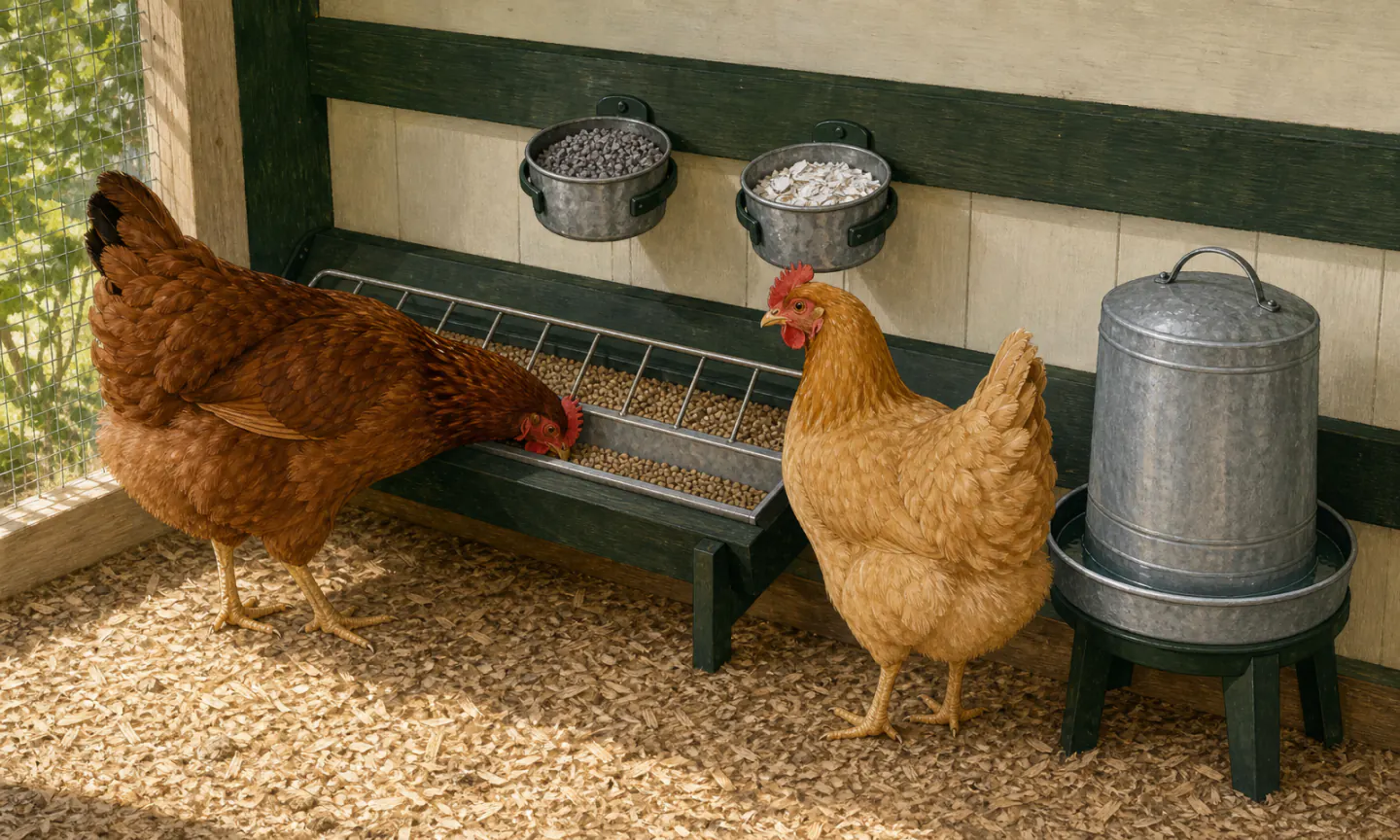
Field note · Separate jobs
Choose feed by life stage, not by the picture on the bag
A complete feed is formulated so its protein, energy, vitamins, and minerals work together. Adding a large amount of grain or scraps does not simply add variety; it lowers the share of that balanced ration in the total diet. Read the purpose, age range, feeding directions, and whether the product is complete or supplemental on the actual label.
| Bird | Typical feed class | Change when | Important caution |
|---|---|---|---|
| New chick | Chick starter | The product label moves the bird to grower, commonly around 6 to 8 weeks | Do not feed layer ration to a growing chick. |
| Growing pullet | Grower or developer | She begins laying or reaches the label's layer transition | Do not rush high-calcium feed because another hen is laying. |
| Active laying hen | Complete layer feed | A veterinarian, nutritionist, or mixed-flock plan requires another ration | Treats still dilute a complete layer ration. |
| Mixed-age flock | A complete all-flock or grower-type ration labeled for every bird present | The flock becomes one compatible life stage | Offer calcium separately so only active layers choose it. |
Penn State's brooding guidance warns that layer feed contains too much calcium for young growing birds. The common transition ages above are planning ranges, not permission to ignore a manufacturer's directions or an individual bird's stage.
Grit and oyster shell solve different problems
| Product | Job | Who gets it | How to offer it |
|---|---|---|---|
| Insoluble poultry grit | Hard particles remain in the gizzard and help grind whole grains, fibrous plants, insects, and other coarse foods. | Birds eating foods beyond finely ground complete feed, especially when natural stone access is uncertain or snow-covered | Free-choice in a separate dry container, using a size labeled for the bird's age. |
| Crushed oyster shell | Supplies supplemental calcium for eggshell formation. | Active laying hens, not chicks or nonlaying growers | Free-choice in a separate dry container so layers regulate their own intake. |
Oregon State Extension is explicit that oyster shell is too soft to replace grit. Outdoor birds may find suitable small stones, but "free range" does not prove the soil contains the right material all year. Supplying labeled grit separately removes that guess when birds eat coarse foods.
Do not mix oyster shell into every bird's feed as a casual fix. A complete layer ration already contains calcium, and a shell problem can also involve age, heat, stress, disease, water, or total feed intake. Use the soft-egg troubleshooting guide when shell quality changes repeatedly.
Free range is enrichment, not a complete ration
Chickens on pasture find insects, seeds, plants, and grit, but availability changes with season, weather, soil, flock density, and the condition of the yard. Oregon State Extension describes pasture as a supplement rather than a substitute for prepared feed. Keep complete feed available even when the flock spends the day roaming.
Watch the feeder, not folklore
Track how quickly feed disappears, but do not restrict a normal laying flock simply because it forages. A sudden intake change can reflect weather, a blocked feeder, pests, bullying, or illness.
Protect feed from wildlife
Use a dry, cleanable feeder and remove spills. Wild birds and rodents can contaminate feed and make consumption impossible to estimate.
Keep the range safe
Fence birds out of treated lawns, unknown toxic plants, compost hazards, spoiled food, road access, and garden areas where manure can contaminate produce.
Plan for bare seasons
Snow, drought, heat, or a picked-clean run can remove the forage and natural grit birds used yesterday. The complete ration and supplied grit remain reliable.
Treats and scratch: keep the math small
Oregon State Extension recommends limiting scratch to roughly 10 to 15 percent of total intake, or no more than the flock finishes in about 20 minutes. Use that as a ceiling for all extras combined, not a separate allowance for scratch, fruit, vegetables, mealworms, and table scraps.
- 1Let birds eat the complete ration before distributing scratch or scraps.
- 2Use small portions spread over clean litter or an enrichment area so the activity does not create one guarded food pile.
- 3Remove wet or uneaten food before it spoils or attracts rodents and flies.
- 4Never feed a plant or household food unless a reliable poultry source confirms it is safe; “natural” is not a safety test.
- 5Stop and reassess when treats reduce complete-feed intake, cause loose spoiled litter, create fighting, or leave birds over- or under-conditioned.
Water is part of the diet
A bird without water soon reduces or stops feed intake. Oregon State Extension notes that chickens drink roughly two to three times as much water by weight as feed, with demand rising in warm weather. Do not size a system only for an average spring day.
- Keep fresh clean water continuously available and use more than one point when a spill, freeze, clog, or dominant bird could block access.
- Set drinkers at the correct height and on stable footing to reduce litter contamination without making access difficult for smaller birds.
- Check every nipple, cup, valve, and reservoir by hand; a full opaque bucket does not prove water reaches the bird.
- Shade summer water and use a safe freeze plan in winter. Clean biofilm and sediment on a schedule appropriate to the system and weather.
Feed storage and a fast troubleshooting check
Store feed dry, cool, and protected from rodents, insects, wild birds, and moisture. Keep the bag label and lot information until the feed is used; that preserves the formulation, expiration guidance, and traceability if a problem or recall appears. Do not pour a new bag over stale feed forever - clean and inspect the container between batches.
| Problem | First checks |
|---|---|
| Feed vanishes too fast | Spills, wild birds, rodents, feeder height, rain damage, flock-count changes, and whether birds are sorting a mash. |
| One bird seems hungry | Resource guarding, crop fill, body condition, beak or mobility problems, and illness. Add access points and observe individuals. |
| Egg production falls | Water interruption, season and molt, heat, hidden nests, age, stress, health, and whether treats displaced layer feed. |
| Shells become thin or soft | Correct layer ration and intake, separate oyster shell, water, heat, age, stress, and veterinary concerns - not calcium alone. |
Frequently asked questions
How much should I feed a backyard chicken each day?
Do free-range chickens still need chicken feed?
Is oyster shell the same as grit?
Do chickens need grit if they only eat pellets or crumble?
Can chicks eat layer feed?
What should a mixed-age flock eat?
Can I make my own chicken feed?
Sources checked
Life-stage feed, water, grit, oyster-shell, pasture, treat, and storage guidance was checked against current Cooperative Extension material on August 9, 2026.