Feeder guide
Best Chicken Feeders to Prevent Waste
Choose a feeder for the problem you need to solve: feed scratched onto the ground, visits from rats or wild birds, or too many refills. Treadle and gravity feeders work differently, and both need dry placement and regular cleaning.
Quick answer
- Grandpa's feeder is the premium pest-resistance choice.
- RentACoop is the smaller-capacity treadle option for modest flocks.
- OverEZ holds a full bag of feed but its open ports are not true rodent exclusion.
- No feeder replaces dry storage, nightly cleanup, and regular inspection.
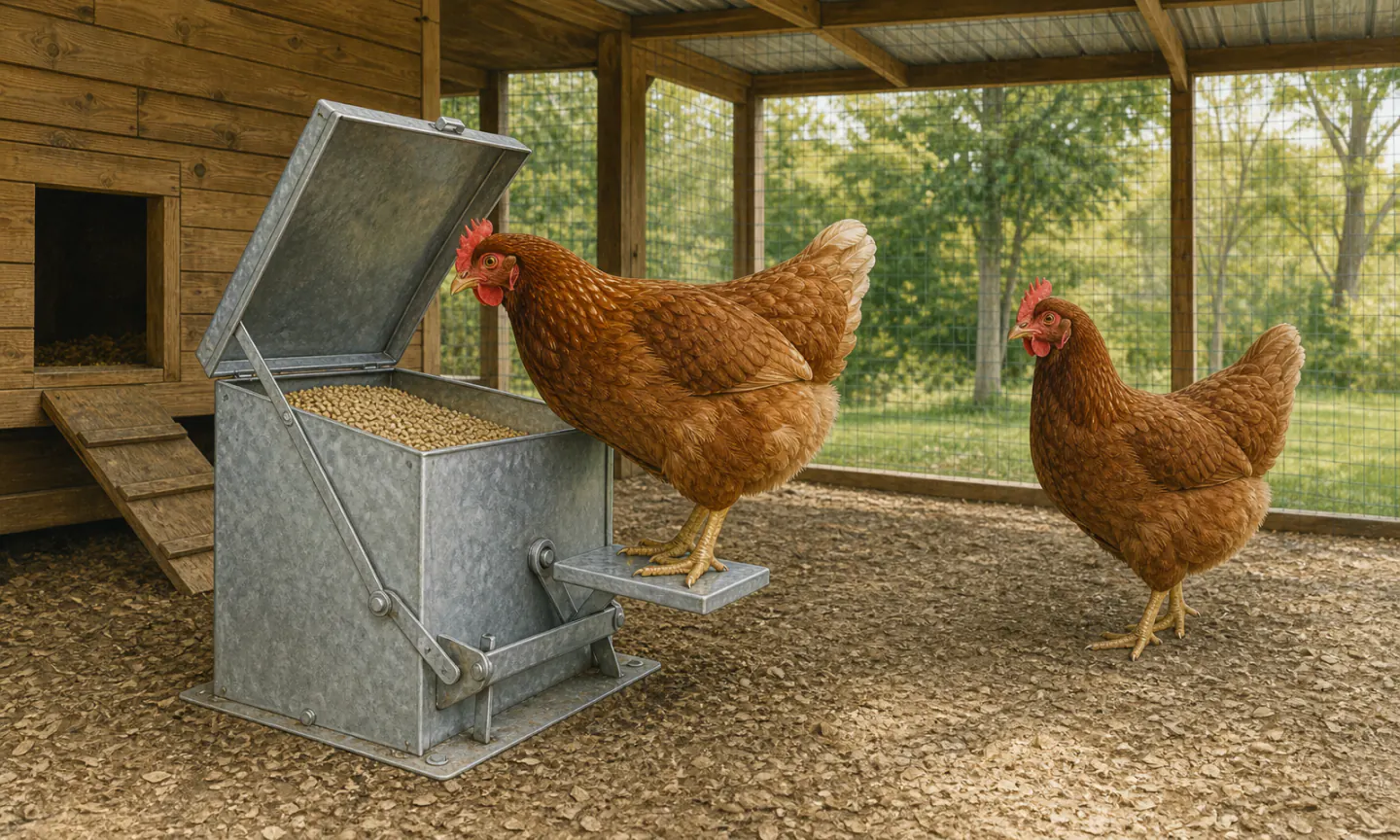
Field note · Covered feed
Start with the problem
Rodents or wild birds
Use a covered treadle feeder, then remove spilled feed and secure bulk bags in a lidded metal container.
Too many refills
Choose capacity by days between checks, but keep a second water and feeding plan for travel. Automation is not unattended animal care.
Rain or damp feed
Prioritize a roofed location, drainage, a raised level base, and ports facing away from prevailing weather.
Compare the feeders
| Retailer | ||||
|---|---|---|---|---|
| Grandpa's Automatic FeederBest pest-resistant feeder | Rodent pressure and long service life | $$$$ | Bird-weight treadle | View on Amazon for Grandpa's Automatic Feeder (affiliate link) |
| OverEZ 50 lb Chicken FeederBest gravity feeder | Large capacity and minimal refill work | $$ | Always-open gravity ports | View on Amazon for OverEZ 50 lb Chicken Feeder (affiliate link) |
| RentACoop 25 lb Treadle FeederBest compact treadle | Small flocks that need a covered treadle feeder | $$$ | Bird-weight treadle | View on Amazon for RentACoop 25 lb Treadle Feeder (affiliate link) |
Three feeder options
A galvanized treadle feeder that opens only when a trained chicken stands on the step, reducing access for rodents and wild birds.
- Best for
- Rodent pressure and long service life
- Power
- Mechanical treadle; no electricity
- Key spec
- 40 lb listed capacity
- Feed is covered when birds are not eating
- Galvanized steel construction
- No batteries, app, or subscription
- High up-front cost
- Requires a careful training period and is not for young chicks
Our take
The premium choice when exposed feed is attracting pests and you are willing to train the flock gradually.
A 25-pound galvanized feeder with a step-open lid, rain cover, anti-roost lid, blinders, and training hardware.
- Best for
- Small flocks that need a covered treadle feeder
- Power
- Mechanical treadle; no electricity
- Key spec
- 25 lb listed capacity
- Smaller footprint than 40-pound treadle feeders
- Training hardware and rain cover included
- Galvanized metal body and stainless hardware
- Not suitable for chicks
- Bedding can obstruct a poorly placed treadle
Our take
A practical middle ground for roughly six adult hens when a 40-pound feeder is larger than the run can accommodate.
A high-capacity gravity feeder with three ports, a wide refill opening, and UV-protected food-safe plastic.
- Best for
- Large capacity and minimal refill work
- Power
- Gravity feed; no electricity
- Key spec
- 50 lb capacity; three feeding ports
- Accepts a full 50-pound bag of feed
- Three birds can eat at once
- Light enough to move when empty
- Open ports do not fully exclude mice or wild birds
- Large filled weight requires a stable base
Our take
Pick it for capacity and simple maintenance, not for true rodent exclusion: unlike a treadle feeder, the ports remain open.
Check whether feed waste actually falls
Keep the feed type, flock, and observation period consistent when comparing feeders. Record how much feed you add and how much dry spill you collect around the base. Note rain, pest visits, and birds that hesitate to use the feeder. A lower refill rate is not proof of savings if some hens stop eating.
A treadle covers feed between visits; open gravity ports can still admit pests. Neither makes spilled feed disappear. Follow training instructions, confirm every bird eats, and keep the area clean before judging the result. No percentage reduction is claimed here.
Set up without risking the flock
- 1Place the feeder on a solid, level, drained surface where bedding cannot jam a treadle.
- 2Follow the manufacturer training positions in order. Confirm every bird eats before advancing.
- 3Weigh or mark feed level during the transition; apparent curiosity is not proof of adequate intake.
- 4Inspect corners and the bottom of the hopper for damp or moldy feed at every refill.
- 5Keep a simple backup feeder ready for an injury, new pullets, or a mechanism failure.
Frequently asked questions
Is a treadle feeder truly rat-proof?
How long does it take chickens to learn a treadle feeder?
Can chicks use an adult treadle feeder?
Can a gravity feeder stay outdoors?
Sources checked
Buying guidance updated September 8, 2026. Product specifications retain their July 18, 2026 source check. We have not measured feed savings or pest exclusion for these feeders.
Keep planning
Rats and chicken coops
Remove feed, water, shelter, and other rodent attractants.
Read nextDIY chicken feeder
Build a washable feeder and test its capacity, edges, crowding, and weather limits.
Read nextCoop cameras
See whether pests visit the feeder after dark and verify that the flock is eating.
Read next