Flock integration guide
How to introduce new chickens to a flock
Treat this as two separate jobs. Quarantine protects the resident flock from disease. Only after that health separation is complete should fence-line familiarization and supervised contact begin. A bird behind wire inside the main run is visible integration - it is not quarantine.
Quick answer
- USDA guidance calls for a 30-day quarantine for new birds, even when they look healthy.
- Keep quarantine equipment, footwear, feed, water, and contact separate; care for resident birds before quarantined birds.
- After quarantine, use a secure barrier so the groups can see one another without reaching or cornering.
- Advance by behavior, not a fixed calendar, and stop immediately for blood, injury, pinning, or blocked feed and water.
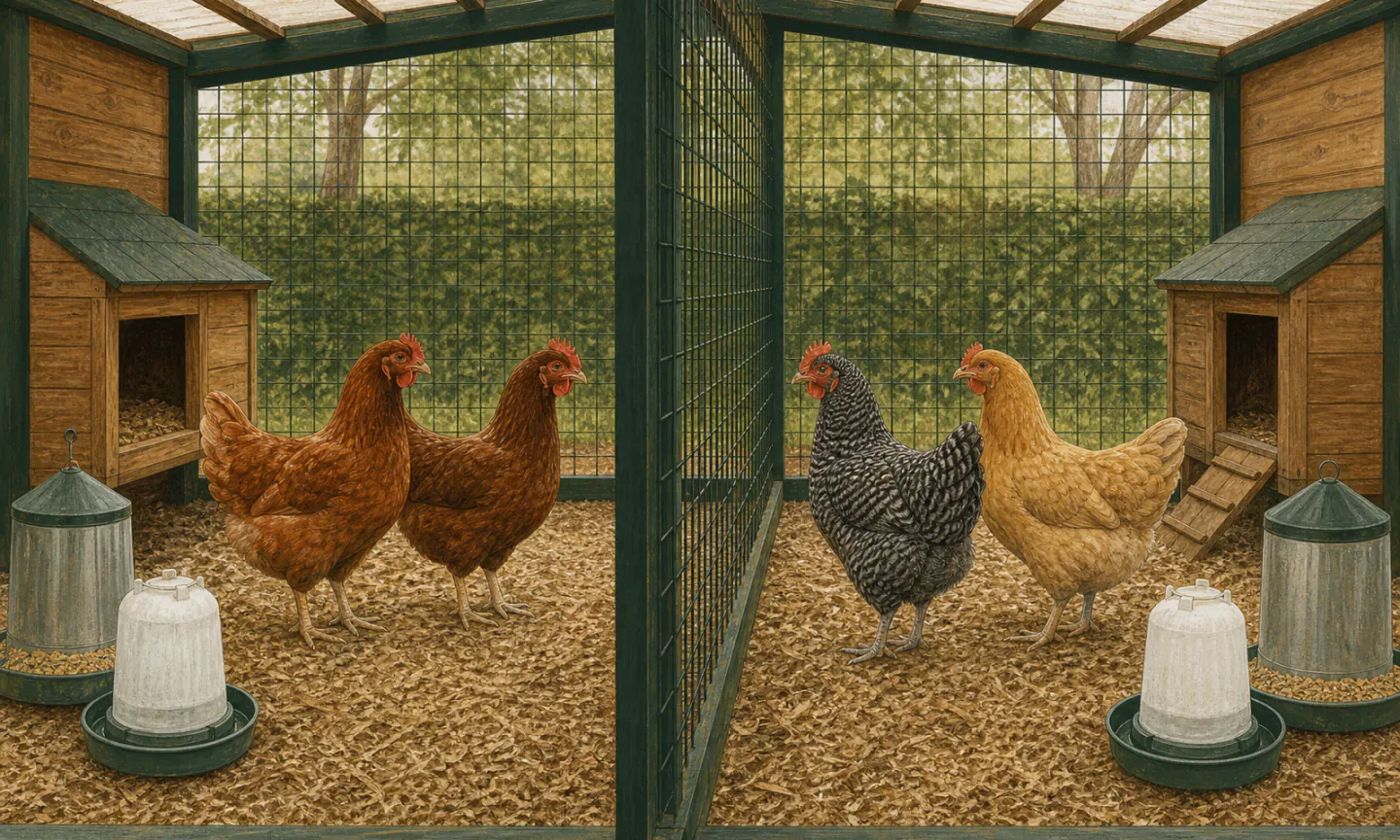
Field note · Protected contact
Quarantine and integration are not the same phase
Health quarantine
A separate location, no direct contact, no shared equipment, and daily health observation. The objective is to keep an unseen pathogen or parasite from reaching the resident flock.
Behavioral integration
Protected visual contact followed by controlled shared space. The objective is to let a new social order form without trapping, starvation, or injury.
USDA's Defend the Flock education material says healthy-looking birds can still carry disease and specifies a 30-day quarantine. A dog crate inside the resident coop, side-by-side pens that share runoff, or one feeder used for both groups may allow contact and therefore does not meet that goal.
Before the new birds come home
- 1Confirm that local law, coop and run space, feed access, roost length, nesting space, manure handling, and backup care can support the larger flock.
- 2Choose a physically separate quarantine location with secure housing, its own feeder and waterer, dedicated cleaning tools, and no shared poultry traffic.
- 3Ask the seller or hatchery about bird age, health history, recent illness, vaccination records, source flock, and National Poultry Improvement Plan participation where applicable.
- 4Arrange poultry-veterinary or extension contact information before a bird becomes ill. Ask whether local disease conditions require testing or a different quarantine plan.
- 5Build the post-quarantine divider and escape structures in advance. A rushed introduction should not happen because the temporary pen was needed elsewhere.
The 30-day health quarantine
Observe every new bird at least daily. USDA's current biosecurity pages advise owners to know the signs of infectious disease and to keep people, equipment, clothing, and footwear from carrying contamination between groups. Care for the established flock first and the quarantine group last; then clean and change as appropriate before returning to resident birds.
Observe
Appetite, water use, droppings, breathing, eyes and nostrils, posture, walking, skin and feathers, and any sudden change from that bird's normal.
Keep separate
Birds, wild-bird exposure where practical, feed bins, waterers, carriers, cleaning tools, boots, gloves, and bedding or manure routes.
Record
Arrival source and date, daily observations, treatments directed by a veterinarian, testing, deaths, and the date the full quarantine can end.
Escalate
Contact a poultry veterinarian or animal-health authority about respiratory signs, neurologic signs, swelling, multiple sick birds, sudden egg-production loss, or unexplained death.
If illness appears, the calendar does not simply resume after the bird seems better. Get a diagnosis and a veterinarian's advice about whether any of the exposed newcomers should ever join the flock.
A behavior-led integration sequence
After quarantine, the University of Arizona Cooperative Extension recommends protected proximity before unbarriered contact and waiting until young birds are close to the adults' size. Do not use an age number alone; feathering, weather, size, mobility, and health all matter.
- 1
Protected visual contact
Place the groups where they can see and hear each other through a secure barrier but cannot peck through gaps. Give both sides their own food, water, shade, and shelter. Continue until most birds can eat, dust bathe, and rest near the divider without constant charging.
- 2
Short supervised meetings
Use a roomy, cluttered area with more than one route away. Begin when you can stay present. End while the birds are settled rather than waiting for a crisis, and separate through a calm gate or panel instead of chasing.
- 3
Longer shared daytime access
Increase time only when the newcomers can move, eat, drink, and rest. Add widely spaced feed and water stations, visual barriers, perches, and open-ended hiding places so no bird can guard every resource.
- 4
Shared run and coop
Move to unsupervised daytime access only after repeated calm sessions. Confirm that every bird enters and leaves the coop, uses a roost, and reaches resources. Night placement is the final housing step, not a substitute for the earlier work.
What is normal, and when should you stop?
Chickens form a social hierarchy, so a completely peck-free introduction is not a realistic target. Alabama Extension explains that adding a bird disrupts a stable pecking order. Your job is to keep that negotiation from becoming sustained harm.
| Usually monitor | Stop and separate safely |
|---|---|
| A brief peck, squawk, or short chase after which both birds disengage | Repeated one-way pursuit, pinning, cornering, or several birds attacking one bird |
| A lower-ranked bird gives way but later returns to normal activity | A bird cannot reach feed, water, shade, the coop door, or a safe resting place |
| No wound, bleeding, persistent feather loss, or decline in condition | Blood, open skin, eye injury, lameness, breathing distress, exhaustion, or worsening feather removal |
Separate an injured bird from pecking, provide appropriate first aid, and contact a poultry veterinarian for anything beyond a minor superficial injury. Before retrying, correct the setup and restart with protected contact. The pecking-order and bullying guide has a full root-cause audit.
Small-flock problems that need a different plan
One new hen
A lone newcomer has no familiar companion and can receive all the flock's attention. When space, law, and welfare allow, adding a compatible group can spread social pressure. A single rescued or surviving hen may still be integrated, but use a longer protected phase and be ready for a separate compatible companion setup if repeated attempts fail.
Chicks and adult hens
Do not place small chicks where adults can reach them. Keep brooder-age birds in the correct chick setup, then begin protected contact when outdoor conditions, feathering, and body size are suitable. Use openings in a well-designed divider only when they are intentionally sized so youngsters can escape and adults cannot follow.
A rooster in either group
A rooster does not replace quarantine or supervision. Adult males can fight intensely, and mating pressure can injure hens. Do not merge male groups casually; get experienced local guidance and maintain a safe permanent separation option.
Only one coop and run
A temporary weatherproof pen, a framed hardware-cloth divider, or a secure kennel inside a larger protected enclosure can create a post-quarantine visual-contact zone. It must still provide adequate space, shade, predator protection, food, and water. Quarantine must happen elsewhere first.
Frequently asked questions
How long should I quarantine new chickens?
Can I put new chickens in the coop after dark?
How long does the see-but-don't-touch stage last?
What age can chicks join adult chickens?
Is pecking during an introduction normal?
Can new chickens share layer feed with the flock?
Sources checked
Quarantine, biosecurity, size, visual-contact, social-order, and injury-prevention guidance was checked against USDA and Cooperative Extension sources on August 9, 2026.
Keep planning
Pecking order or bullying?
Know which interactions to watch and which ones require immediate separation.
Read nextRaise chicks safely
Get brooder heat, water, feed, litter, and monitoring right before integration age.
Read nextCheck the flock size
Make sure the coop, run, waste plan, and local limit support more birds.
Read next