Chicken behavior guide
Chicken pecking order vs. bullying: when to intervene
A pecking order is a social hierarchy, not permission for a bird to be injured or excluded from basic resources. Brief pecks and short chases can settle rank. Repeated one-way pursuit, feather removal, wounds, or a hen that cannot eat, drink, rest, or escape requires action.
Quick answer
- Monitor brief, reciprocal disputes that end with both birds returning to normal activity.
- Intervene for blood, open skin, persistent feather removal, pinning, cornering, exhaustion, or blocked feed and water.
- Remove an injured target from active pecking, address the wound with veterinary guidance, and hide or remove blood promptly.
- Audit space, resource access, heat, light, diet, flock changes, injury, and opportunities to forage before relying on a social-media remedy.
The line is harm, not noise
Alabama Extension explains that a stable flock recognizes individual birds and their rank. A move, molt, illness, broody period, or new bird can unsettle that order. Some pecking and squawking may follow; the useful question is whether each bird can still function safely.
| Monitor closely | Intervene now |
|---|---|
| One or two quick pecks, a brief squawk, or a short chase | Long or repeated one-way pursuit, pinning, cornering, piling on, or attacks whenever the target moves |
| The lower-ranked bird yields, leaves, and later resumes eating, drinking, foraging, and resting | A bird is kept from feed, water, shade, roosts, nests, the pop door, or the flock's safe area |
| No blood, open skin, persistent bald area, limp, eye injury, or loss of condition | Pulled feathers, exposed or bleeding skin, vent pecking, lameness, eye trauma, weight loss, dehydration, lethargy, or collapse |
| Disagreement decreases as the flock settles | Intensity or number of attackers increases, or the same bird is targeted day after day |
Mississippi State Extension distinguishes mild feather pecking used in social ranking from cannibalism, which damages and consumes skin or tissue. Do not wait for cannibalism to prove that a pattern is serious; resource exclusion and progressive feather damage are earlier welfare failures.
A seven-part cause audit
Harmful pecking can spread as a learned behavior, so correct likely triggers early. The Mississippi State Extension review identifies crowding, heat, excessive light, restricted feed or water, unbalanced diet, flock mixing, nest conditions, and exposed injury among the triggers.
- 1
Usable space
Measure the coop and secure run rather than total yard acreage. Watch where birds actually spend a rainy day, a snow day, and the hour before roost. Add open floor area, perches, platforms, and visual breaks without creating dead ends.
- 2
Feed and water access
Use several widely separated stations. Observe whether the bottom bird can eat for a sustained period, not merely dart in for one bite. A second feeder beside the first can still be guarded by one hen.
- 3
Complete nutrition
Confirm that every bird receives a complete feed for its life stage and that scratch, scraps, and treats have not displaced it. Do not add random protein or salt to a balanced feed as a guess.
- 4
Heat and light
Reduce heat stress and remove harsh or excessive artificial light. Bright nest areas and long lighting periods can worsen pecking; follow extension and product guidance for any necessary lighting.
- 5
Flock disruption
New birds, returning patients, broodiness, a death, a move, or a major coop change can reset social relationships. Use protected reintroduction instead of dropping a separated hen back into the group.
- 6
Injury or illness
Inspect the target for wounds, parasites, mobility problems, abnormal breathing, weight loss, vent problems, or any change from normal. Get veterinary help rather than assuming every isolated hen is socially weak.
- 7
Behavioral opportunity
Provide dry litter or suitable substrate for scratching, a dust-bath area, perches, and safe foraging enrichment. Alabama Extension notes that frustration of highly motivated foraging and comfort behaviors can contribute to abnormal pecking.
What to do in the first hour
- 1Stop active harm with a panel, towel, or calm physical separation; avoid turning the entire flock into a chase.
- 2Move a bleeding or injured bird to safe recovery housing and obtain veterinary direction for wound care, pain, infection risk, eye damage, lameness, or deep tissue injury.
- 3Confirm that every remaining bird can reach clean water, complete feed, shade or shelter, and a safe roost area.
- 4Identify the instigator and the context by direct observation or camera: one bird, several birds, one location, one resource, one time of day, or one visible wound.
- 5Correct the obvious trigger immediately - heat, failed waterer, empty feeder, harsh light, dead-end hiding place, or exposed blood - then begin the full audit.
Separation is management, not a magic reset
Forum advice often recommends removing either the aggressor or the victim for a fixed number of days. Temporary separation can protect a bird and give you time to correct the environment, but the returning bird may be treated as a newcomer and the hierarchy may change again. There is no reliable three-day switch that solves every flock.
Separate the injured bird when safety requires it
Recovery housing must be secure and social isolation should be minimized where safe. Do not reintroduce until the wound is closed, the bird is stable, and the cause has been addressed.
Manage a persistent aggressor
A separate pen may stop immediate attacks and reveal whether one bird drives the pattern. Reintroduction still needs protected contact and supervision; repeated severe behavior may require permanent separation or responsible rehoming.
Do not punish by deprivation
Every separated bird still needs suitable space, companionship planning, complete feed, water, shade, weather protection, and predator security.
Restart as an integration
Use a barrier, multiple resources, escape routes, and supervised contact. Follow the full step-by-step guide rather than opening the crate at bedtime and hoping.
See how to introduce or reintroduce chickens for quarantine distinctions, barrier setup, progression, and stop rules.
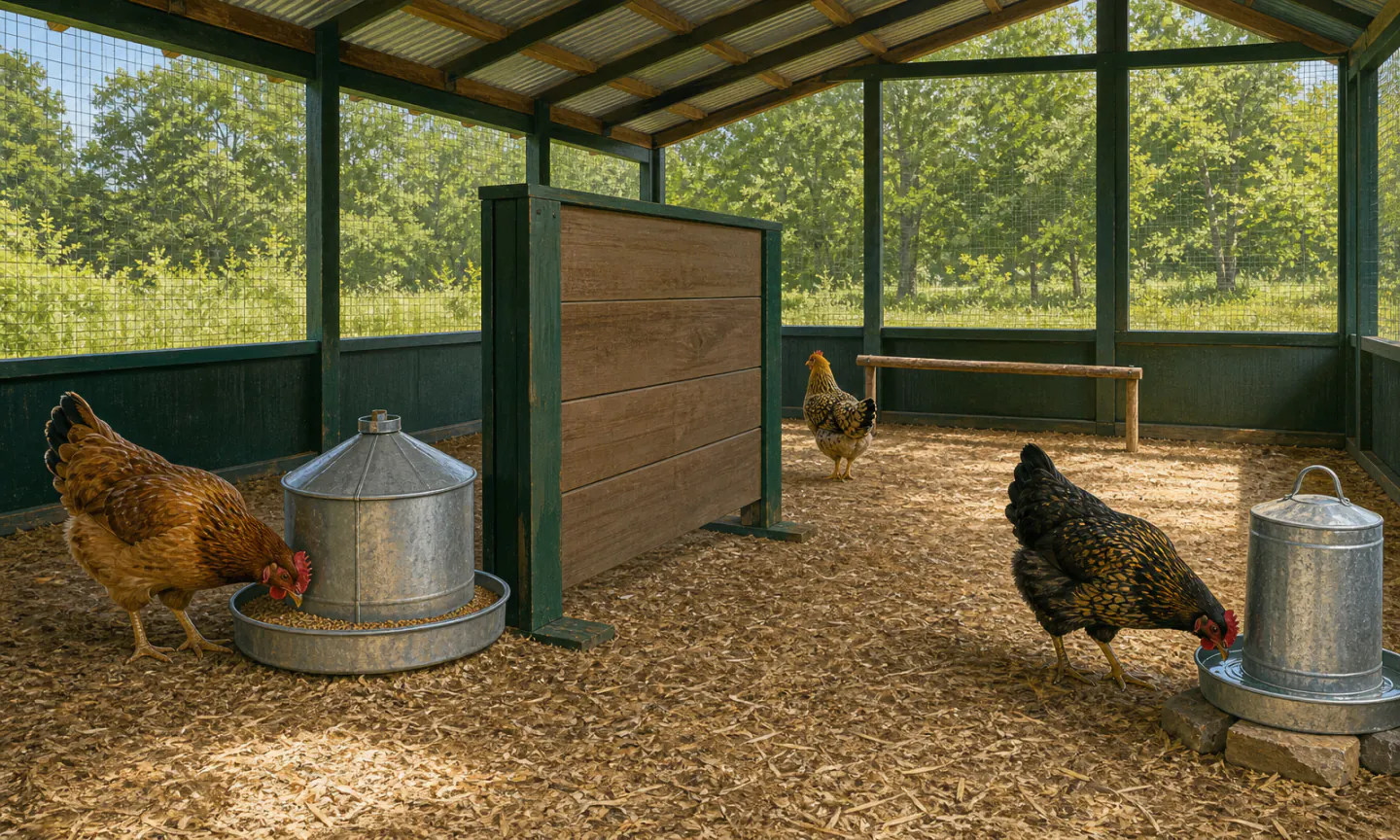
Field note · Break sight lines
Design the run so a lower-ranked hen can succeed
A large empty rectangle can still be socially difficult because dominant birds see and intercept every route. Add structure without sacrificing cleanability or predator protection.
Two or more separated feed and water zones
Place them far enough apart that one bird cannot stand in the middle and guard both.
Visual barriers
Use secure panels, branches, or platforms that break sight lines while leaving more than one exit.
Perches at useful heights
Offer resting and escape options that small, older, or less agile birds can actually reach.
Open-ended shelters
A tunnel or lean-to needs an exit at each end; a one-door box can become a trap.
Foraging substrate
Dry litter, leaves, or another safe scratchable material supports normal pecking and exploration.
Enough secure weather space
The flock needs workable area during the conditions that keep it confined, not only on ideal free-range afternoons.
Be cautious with quick fixes
Colored wound sprays, pinless peepers, beak trimming, bitter products, and physical "dominance" techniques are often suggested online. Each can have welfare, handling, toxicity, or legal implications and none corrects crowding, heat, nutrition, inaccessible resources, or illness. Do not put a product on broken skin unless it is labeled for poultry and appropriate for the wound under veterinary direction. Never attempt beak trimming yourself; Mississippi State states that only trained personnel with correct equipment should perform it.
If severe pecking continues after environmental correction and careful reintroduction, ask a poultry veterinarian or Extension specialist to review the flock and housing. A permanent compatible subgroup or responsible rehoming may be safer than repeated cycles of injury.
Frequently asked questions
How much pecking is normal in a chicken flock?
Should I remove the bully or the bullied chicken?
Why did my flock suddenly turn on one hen?
Will more space stop chicken bullying?
Do pinless peepers stop bullying?
When can an injured hen go back to the flock?
Sources checked
Hierarchy, feather-pecking, cannibalism, foraging, space, nutrition, light, heat, and injury guidance was checked against Cooperative Extension sources on August 9, 2026.
Keep planning
Integrate birds slowly
Use quarantine, protected contact, supervised meetings, and explicit stop rules.
Read nextCheck the ration
Match complete feed to age and keep treats from creating deficiencies or competition.
Read nextRecheck flock capacity
Usable coop and run space matter more than total acreage.
Read next